Compress PDF for Exact Online: Keep Invoices, Receipts, and Bookkeeping Files Small Without Slowing Review
To compress a PDF for Exact Online, upload the final invoice, receipt bundle, bank statement, VAT support file, or bookkeeping packet to LifetimePDF's Compress PDF tool, start with Medium compression, and keep the smaller copy only if supplier names, invoice numbers, dates, VAT figures, totals, and payment references still read clearly.
For most Exact Online workflows, under 2MB is a strong target for text-heavy invoices and standard support, while scan-heavy receipt packs, bank backup, and mixed bookkeeping attachments usually fit better around 2MB to 5MB after light cleanup.
Exact Online PDFs usually become heavy for ordinary reasons. A clean invoice picks up receipt scans, statement pages, VAT backup, accountant notes, approval screenshots, or old archive pages that were never trimmed out. The best result is not the tiniest file possible. It is a smaller PDF that still feels dependable when you, your bookkeeper, your accountant, or an auditor reopens it later and needs one exact date, one VAT line, or one payment reference to be unmistakable.
Fastest path: use LifetimePDF's Compress PDF tool at Medium, then clean up extra pages, split oversized packets, or run OCR only if the file is still heavier than the next Exact Online step really needs.
Need the short version? Jump to Quick start: compress an Exact Online PDF in about 2 minutes.
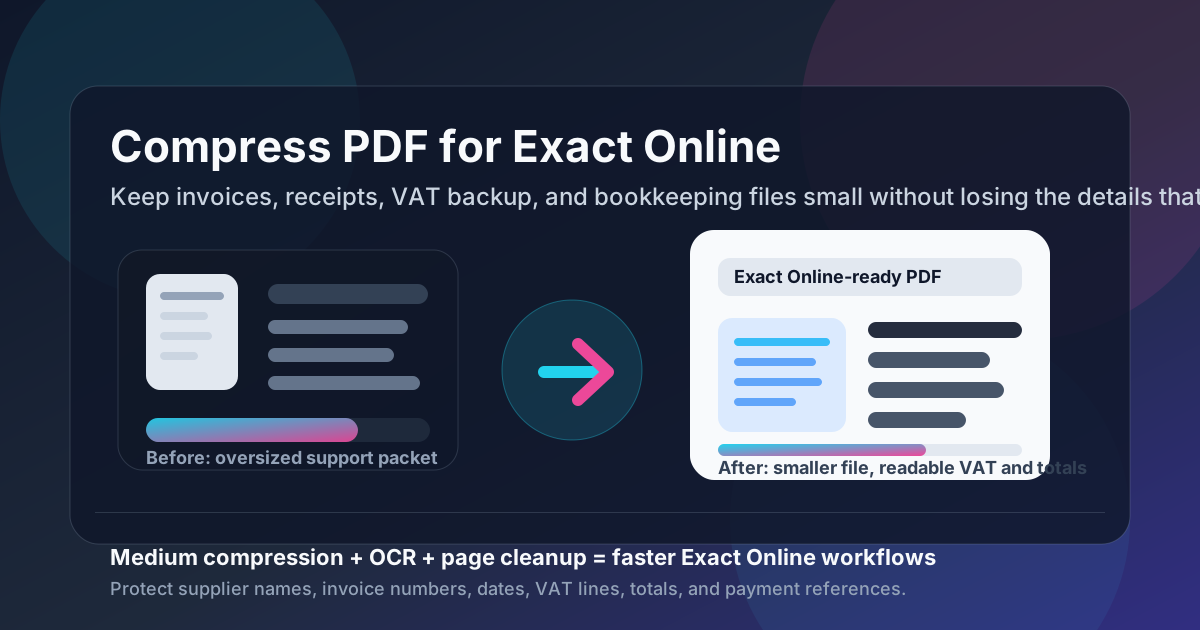
Table of contents
- Quick start: compress an Exact Online PDF in about 2 minutes
- Why Exact Online PDFs get bulky
- What file size should you aim for?
- Which compression level should you choose?
- Step-by-step: shrink an Exact Online PDF with LifetimePDF
- Best approach for common Exact Online document types
- What to clean up before compressing harder
- How to keep bookkeeping details readable
- Workflow habits that reduce PDF bloat
- Related LifetimePDF tools and useful reading
- FAQ (People Also Ask)
Quick start: compress an Exact Online PDF in about 2 minutes
If your real goal is simply make this Exact Online PDF smaller so it is easier to upload, review, or archive, this workflow is usually enough:
- Start with the invoice PDF, receipt packet, bank statement, VAT support file, or bookkeeping bundle you actually plan to keep.
- Open Compress PDF.
- Choose Medium compression first.
- Download the smaller result and compare the new file size.
- Check the fragile details once: supplier names, invoice numbers, dates, VAT lines, totals, payment references, and any tiny receipt text.
- If the file came from a scan or the text is not selectable, run OCR PDF.
- If the packet still feels bulky, remove duplicate pages, crop dead space, or split the appendix before trying stronger compression.
Why Exact Online PDFs get bulky
Exact Online sits in the kind of workflow where one PDF often becomes proof, not just an attachment. That could be a purchase invoice, receipt packet, statement page, VAT support file, customer invoice backup, or year-end bookkeeping handoff bundle. Each page may look reasonable on its own. The size problem usually appears after exporting, scanning, merging, printing, emailing, and saving the same material more times than the workflow really needed.
Smaller PDFs help because they reduce friction where timing and trust both matter. They open faster during bookkeeping review, upload more smoothly when several files move in the same step, and are easier to revisit when someone needs to confirm one supplier, one date, one tax amount, or one payment reference later. The goal is not to flatten the evidence until it looks weak. The goal is to remove wasted image weight while keeping the record trustworthy.
- Faster attachment handling: lighter files move through upload, handoff, and archive steps with less drag.
- Smoother review: smaller PDFs are easier to open when someone needs to verify supplier names, invoice numbers, VAT lines, totals, or statement references.
- Less scan waste: phone captures, receipt scans, and bank paperwork often include shadows, blank backs, and thick borders nobody needs.
- Cleaner archives: smaller files are easier to resend, reopen, and store without carrying pointless bloat forward.
- Better downstream prep: leaner PDFs are easier to OCR, crop, split, extract from, or compare if the bookkeeping workflow changes later.
What file size should you aim for?
There is no single magic number for every Exact Online workflow, so practical ranges are more useful than chasing one exact limit. You want a file that stays easy to upload, open, and trust when someone is checking supplier details, VAT figures, dates, totals, bank references, or payment evidence.
| Document type | Practical target | What matters most |
|---|---|---|
| Text-heavy invoice, statement, or normal support PDF | About 0.5MB to 2MB | Supplier names, invoice numbers, dates, VAT lines, and totals |
| Receipt packet, bookkeeping bundle, or mixed support file | About 1MB to 3MB | Merchant names, dates, tax amounts, and small annotations |
| Scan-heavy bank backup or year-end support | About 2MB to 5MB | Fine print, stamps, signatures, and faint printed detail |
| Anything above 5MB | Usually needs cleanup first | At that size, duplicate pages, empty borders, or unnecessary appendix content are often the real issue |
The right range depends on what the next reviewer truly needs. If the PDF exists to prove a supplier, a date, a VAT amount, a payment, or a bookkeeping adjustment, protect those details first. The useful goal is not a dramatic percentage reduction. It is a file that feels easier to work with in a real accounting workflow.
Which compression level should you choose?
The easiest mistake is jumping straight to the strongest setting because the file feels annoyingly large. That is how you turn a clean invoice or support packet into soft VAT lines and fuzzy totals. For most Exact Online PDFs, a measured order works better:
- Low compression: useful when the PDF is already fairly clean and only needs a light trim.
- Medium compression: the best default for most invoices, receipt packs, statement pages, VAT backup, and approval-ready bookkeeping PDFs.
- High compression: worth testing only after removing duplicate pages, cropping scan waste, or splitting an oversized packet.
Step-by-step: shrink an Exact Online PDF with LifetimePDF
- Save the final working copy first. Use the file you actually plan to attach or archive, not an early draft full of pages nobody needs anymore.
- Open Compress PDF.
- Upload the file. This could be a purchase invoice, sales invoice, receipt bundle, bank statement, VAT support packet, or accountant handoff file.
- Start with Medium compression. It is usually the safest first pass for Exact Online support files.
- Download the smaller result. Check the new size and decide whether it already feels easier to handle.
- Preview the weak spots. Look at supplier names, invoice numbers, dates, VAT lines, totals, bank references, and any tiny printed receipt detail.
- Use OCR or structure fixes only if needed. If the file is still too heavy, run OCR PDF, remove duplicate pages, extract the useful section, or split the appendix before trying a stronger setting.
Useful sequence: compress first, then clean the packet structure. In bookkeeping workflows, the oversized file is often carrying too much baggage, not too little compression.
Best approach for common Exact Online document types
1. Purchase invoices and supplier bills
These usually compress well because the most important information is text-based. Medium compression is often enough. The real risk is not losing a logo. It is softening the invoice number, supplier name, VAT breakdown, due date, or final total just enough to slow the next reviewer down.
2. Receipts and expense backup
Receipt-heavy PDFs carry a lot of wasted image data. If the packet still feels huge after one pass, the fix is often cleanup rather than harsher compression. Remove blank backs, crop dead space, and keep only the pages the reviewer actually needs. OCR is especially helpful here because receipts often come back later when somebody needs to search by vendor, amount, tax, or date.
3. Bank statements and reconciliation support
These packets often mix statement pages, screenshots, notes, and supporting records into one bundle. Medium compression is usually the safer starting point. If the file stays heavy, remove duplicate scans and blank backs before pushing harder, because those pages often create more bloat than the real evidence inside the packet.
4. Sales invoices and customer-support records
Clean exported customer invoices usually do not need aggressive compression. A lighter setting often works. What matters is keeping invoice numbers, dates, amounts, customer details, and payment references easy to read if the file is reopened during follow-up or collection work.
5. Year-end, VAT, and accountant handoff packs
These are often the heaviest files because they combine several support types in one place. Medium compression is usually the best first move. If the packet is still too large, split unrelated support into smaller files instead of forcing one oversized PDF to carry every appendix page forever.
What to clean up before compressing harder
When an Exact Online PDF stays heavy after one reasonable compression pass, the issue is often packaging rather than image density. Try these in order:
- Delete repeated or blank pages. This fixes more than people expect in bookkeeping support packets.
- Extract only the pages the next reviewer needs. A focused six-page packet is usually better than a thirty-page archive dump.
- Split the appendix. Keep the main support in one PDF and the backup evidence in another.
- Crop empty borders and background. Scan waste adds size without adding proof.
- Run OCR on image-only paperwork. Searchability matters long after the first upload.
- Only then try stronger compression. By that point, the file is usually leaner already.
How to keep bookkeeping details readable
Before you keep the compressed copy, check the weakest details on the page rather than the strongest ones. Headings almost always survive. The useful details are what quietly fail.
- Supplier or customer names: confirm they are still crisp.
- Invoice numbers and dates: especially on scans and statement excerpts.
- VAT lines, subtotals, and totals: numbers should still read cleanly without guesswork.
- Payment references and bank details: zoom in on the densest section once.
- Approval comments or supporting notes: these are easy to lose when the original screenshot or scan was weak.
- Handwritten marks, stamps, or signatures: protect them if they matter later.
A 20-second review saves far more time than rebuilding a packet later because somebody could not read one number or one note that mattered.
Workflow habits that reduce PDF bloat
- Export once from the cleanest source available. Reprinting and rescanning usually adds size without adding value.
- Trim before you merge. It is easier to keep one support packet clean than to repair a giant combined PDF later.
- Separate summary from appendix. Not every reviewer needs every page.
- Use OCR on paper-origin files. Searchable PDFs age better in bookkeeping archives.
- Review one sample page before forwarding everything onward. Catching blur early is cheaper than resending a packet later.
Related LifetimePDF tools and useful reading
Exact Online document prep often turns into a few follow-on tasks. These tools usually pair well with compression:
- Compress PDF for the first size-reduction pass.
- OCR PDF for scanned invoices, receipts, and statement support.
- Extract Pages when only part of the packet needs to travel.
- Delete Pages to remove duplicate or blank support pages.
- Split PDF when one packet is doing two jobs at once.
- Crop PDF to trim dead scan borders.
- PDF Metadata Editor to clean hidden title and document properties before distribution.
If you want adjacent reading, these guides fit the same workflow family: upload-focused Exact Online guide, Compress PDF for Business Central, Compress PDF for NetSuite, Compress PDF for ERPNext, Compress PDF for Sage 50, Compress PDF for Xero, and Compress PDF for QuickBooks.
Bottom line: if the Exact Online PDF is too large, start with Medium compression, protect the bookkeeping details that matter, and clean the packet structure before you force the file any harder.
FAQ (People Also Ask)
How do I compress a PDF for Exact Online?
Upload the Exact Online-ready PDF to a PDF compressor, start with Medium compression, and keep the smaller copy only after checking supplier names, invoice numbers, dates, VAT figures, totals, and payment references. For most bookkeeping support PDFs, Medium is the safest starting point because it reduces file size without weakening review clarity.
What file size should I aim for with Exact Online PDFs?
Text-heavy invoices, statement pages, and standard support files usually work well under 2MB. Receipt bundles, bank backup, and scan-heavy support often land better around 2MB to 5MB as long as the smallest useful details remain easy to read.
Will compression make VAT lines or payment references blurry?
It can if you compress too aggressively. That is why Medium compression is usually the best first move. Always review invoice numbers, dates, VAT lines, totals, payment references, and the smallest printed text before you keep the smaller file.
Should I run OCR on scanned Exact Online attachments?
Usually yes if the PDF came from a scanner or phone camera and the text is not selectable. OCR makes invoices, receipt bundles, bank support, and bookkeeping files easier to search, validate, and reuse later during reconciliation, VAT review, accountant handoff, and audit work.
What if the Exact Online PDF is still too large after compression?
Delete duplicate pages, crop empty scan borders, split one oversized packet into summary and appendix files, or extract only the pages the next reviewer actually needs. In many Exact Online workflows, better packet structure helps more than stronger compression.